As an attending physician in the intensive care unit (ICU), I just couldn't keep leading morning rounds using a sedation vacation (some vacation!). I would introduce myself, tell the patients where they were and how they were doing, ask them to show me two fingers, a little "look, listen and feel," and then leave to discuss the case with the team. The patient's nurse restarted the sedation/sedative medications and resecured the physical restraints in order to join our discussion. The patient was safe, but immobile and likely hallucinating with delirium until the next morning's rounds. That scenario may be a bit of an exaggeration in that physical and occupational therapy might visit during the day, and there might be another opportunity to temporarily lighten sedation, but it's not far from true in many cases.
To improve the situation, I formed an interdisciplinary committee in 2010 composed of nurses, therapists such as physical (PT), occupational (OT), speech (ST) and respiratory (RT), the volunteer department, administration, palliative care and nutrition. We met, planned and implemented the program to include touch therapy, facing patients to the hallway for staff to engage them on their walkarounds, and portable homemade 'play stations' with items such as mirrors and magazines. We also began taking vented patients outside to the garden to sit with family and ambulating almost anyone who was able. It worked. Their families interacted with us more and appeared less distressed. We collaborated more closely with our therapy teams, and most importantly, our patients were alert and participating in their care.
Fast forward to today with the Society of Critical Care Medicine (SCCM) ICU Liberation Bundle (A-F), which many institutions implement letter by letter since each element of the bundle can be a lot to take in all at once. A-F parallels my ideals, so I thought I might share my perspective from my activities back in 2010 when our critical care unit went rogue. We started and ended with the 'why' and reminded ourselves at every weekly meeting. If you can remember the 'why' of delirium, physical restraint and sedation prevention/minimization, and learn a little about how everything is connected, you will make the right decision every time. A great resource to help you as you make these changes in your ICU is the 'AACN Awake and Walking ICU: Mastery of the ABCDEF Bundle' webinar.
ICU Liberation Bundle (A-F)
Integrating common-sense themes
Certainly, there are risks we cannot influence that can lead to deliriogenic complications (e.g., sepsis preantibiotic; alcohol/ETOH withdrawal course), so let's not consider those for now. Let's discuss the risks we can influence and start with reducing the A-F bundle to two actions: physical and chemical restraint reduction. Pretty radical, but if we use common sense, we can get through it. We can start with an abbreviated version of what we know about the bundle elements:
- A Pain
- B Weaning trials
- C Sedating medications
Now we get to the part where the letters match:
- D Delirium
- E Early mobility
- F Family
If a family member were in the ICU, you would want to salvage whatever cognition and mobility they had before they became acutely ill. This means:
- Engaging them cognitively
- Letting them do as much themselves as possible
- Ending dependency on equipment as soon as possible
So instead of tackling each element with separate policies and procedures, and measuring your progress before moving to the next letter, think of your part in the bundle this way:
- Keep patients as awake and as cognitively engaged as possible - especially with family
- Untie them from the bed, and tolerate safe movement
- Wean them from everything every time you can
You manage pain as part of your normal practice anyway. That will take care of itself.
What, you ask? You're probably thinking that if you don't stay at the bedside, you don't have the means to keep patients safe while they are untied from the bed or awake but not agitated. How do you minimize delirium, immobility and sedation? A good restraint alternative that can be tailored to the patient's needs could address this issue.
If the patient is safely untied from the bed with minimal sedation, you've accomplished:
- Element A: Better assessing pain in a more awake patient to make sure it is not a factor - without overmedicating. The ordering provider will deal with the least harmful pain medications.
- Element B: Patients being awake enough for secretion clearance and diaphragmatic strength to pass a weaning trial
- Element C: Agitation reduction from restraint freedom allowing better sedation options
- Element D: Delirium risk reduction from restraint and sedation reduction (two risk factors)
- Element E: Increased patient-driven early mobility from restraint reduction
- Element F: Family involvement with a more awake/mobile, less agitated/sedated patient
A-F bundle compliance can be accomplished because of safe freedom of movement! Before you're concerned about minor patient discomfort from an ET tube or joint aches, think about this: Increasing delirium and muscle-wasting for an at-risk patient with comfort meds to prevent minor temporary discomfort is not a good return on investment and can result in chronic pain later. As I recall one survivor of delirium putting it, It's either hell for a week or hell for the rest of your life."
Unless you plan to stay by the bedside with a keen eye on your awake and untied patient, you'll need help.
Getting to Safe Mobility
What restraint alternative tools are available and what should you know about them?
Elbow Immobilizers
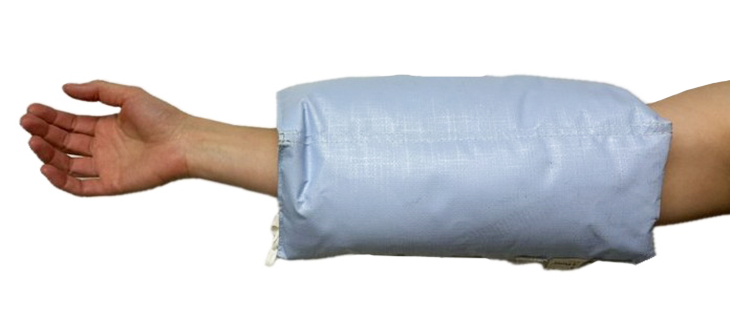
Some examples of elbow immobilizers are open arm boards generally used as arterial line/IV stabilizing structures during and after procedures, and the wrap-around elbow immobilizer depicted in the photo to the right, often called a freedom splint. Both allow arm movement. For nursing, quality & safety, and risk management concerns, the wrap-around elbow immobilizer obstructs much of the arm, obscuring IVs and increasing risk of skin maceration if not removed periodically, and arm movement can lead to entanglement in IV lines with subsequent dislodgement. Self-removal by patients is relatively easy for a more awake patient.
Soft Bed-Attached Restraints
An example of a soft bed-attached restraint is a soft wrist restraint, which is very lightweight, small, and can prevent tube and line removal in heavily sedated, weakened patients. For patients, being strapped to their bed can be agitating, frightening and lead to a sense of victimization, dehumanization and imprisonment. For nurses, the devices can cover arterial and back-of-hand IV areas. For therapists, wrist restraints immobilize joints, which can lead to a shoulder injury, create fewer opportunities for therapy sessions due to the sedation required for patient tolerance, and can lead to a prolonged rehabilitation course due to muscle wasting from resultant immobility. For those with quality & safety and risk management roles, in more lightly sedated or stronger patients, wrist restraints are known to result in self-extubations by patients reaching their head toward the restrained hand for tube removal. Another downside is that patients can develop neurovascular injury from the wrist restraint tightening around an edematous hand, despite frequent restraint checks. Immobility from wrist restraints is an independent risk factor for delirium, hospital-acquired pressure injury, frailty, reduced secretion clearance, gut dysmotility and muscle wasting.
Soft Tied or Untied Restraints
An example of this type of restraint is a mitt restraint, which can be untied or tied to the bed. In some institutions, the untied configuration may be considered a non-restraint. For coherent patients, when mitt restraints are untied or loosely tied to the bed, they can offer freedom of movement while serving as a reminder not to dislodge tubes and lines. Some mitt restraints restrict finger movement and grasping function capabilities. For nurses, some mitts can require manipulation for visibility and access to hand, wrist and arterial line areas. Untied options can result in entanglement of arms in IV lines. For quality & safety and risk managers, mitt restraints in the untied configuration can be inadvertently squeezed around the ET tube by confused patients for self-extubation. Mitt restraints, similar to wrist restraints, circumferentially bind wrists, which can lead to neurovascular injury and hand edema. Separate IV holders, which may lead to potential entanglement in IVs during arm movement, generally wrap around the arm, creating risk to the awake patient.
Titratable Patient Mobility and Security System
An example of this type of device is a Refraint, which has undergone phase II randomized control trials for safety and efficacy. The device has features to benefit the nurse, therapist and patient, and even has something for the quality & safety officers and risk managers in the group. For patients, it allows arm movement, freedom, handholding and a greater sense of autonomy and dignity.
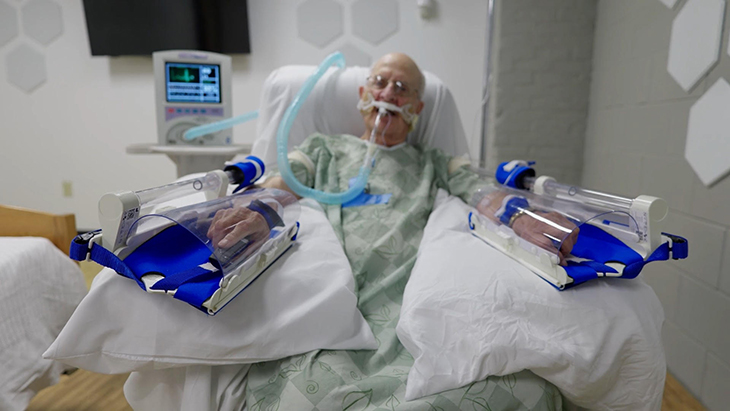
For nurses, it affords empowerment and safety through titratability with tied, untied and flexible bed-tie options, clear access to arterial and back-of-hand IV areas, a built-in secure IV management system, and depending on institutional policy it can be classified as a non-restraint when not tied to the bed for reduced documentation requirements while still deterring tube or line dislodgement.
For therapists, there are hand/finger dexterity exercises with a built-in OT tool, mobility for all joints, a resistance exercise bed strap with markings for patient therapy sessions or in-between patient 'homework.' For quality and safety enthusiasts, it is lightweight, padded, and pressure and skin-friendly. For comfort and safety, there is an auto-adjusting wrist strap (attached to the device rather than the bed) to prevent hand edema and neurovascular injury, and help ensure patient safety from tube and line entanglement that could lead to dislodgement.
For nurse leaders, this type of device can result in faster bed turnover if a no-restraint status is required to move patients out of the ICU or to outside facilities (individual institutional approval required).
On the risk management side, there are built-in delirium-reducing measures such as sedation and immobility reduction (two significant independent risk factors for delirium) through safe, in-bed patient-driven movement. This device is the only all-in-one CMS-compliant least restrictive intervention and the only one to have been put through rigorous multisite randomized controlled trials (phase I published; phase II submitted for publication). On the downside, it is bulkier than the smaller options and requires some training. Also, the culture change for an awake and mobile patient that follows Refraint can take some getting used to.
Chemical Restraints
Chemical restraints include sedation, pain medications and antipsychotics. Sedating medications are beneficial for appropriate diagnoses such as seizures, some withdrawals and agitated psychosis. However, sedation is an independent risk factor for delirium and can result in immobility, which can lead to gut dysmotility, reduced pulmonary secretion clearance, muscle wasting and frailty. Often, sedation results in restraint, and restraint results in sedation. Delirium from either can lead to hallucinations that become lasting false memories and post-intensive care syndrome (PICS). Institutions that promote chemical restraint as an avoidance measure for physical restraint are basically trading one evil for another. Both often cause lasting patient harm.
Bedside Sitters
Patient sitters include 1:1 assignments and nursing assistants at the bedside. In some cases, sitters categorize patients as unrestrained to satisfy potential accepting facility (e.g., LTACH) regulations. Some sitters are allowed to stop risky behaviors through physical intervention, and some are only allowed to notify the nurse of dangerous behavior, often after that behavior culminates in an unwanted event. In some situations, sedation may be co-administered for safety, or patients may be more awake. Arm movement is possible but not encouraged and often prohibited by sitters who stop an arm raising off the bed - a version of manual restraint. Literature shows that patients with delirium often feel that their sitters are guards sent to control them. For nurse leaders, human resources are scarce and expensive.
Tele-sitters
Tele-sitters include internal (to the institution) and external (third-party) providers. Tele-sitters are often more available than in-person bedside sitters and have varying costs. Patients are allowed to move their arms, but sedating medications may be used for added safety. From a confused patient perspective (generally the type of patient prompting a sitter), a voice coming from a screen telling them not to move can be deliriogenic. Tele-sitters notify nurses of risky behaviors and may not be in time to prevent unwanted events such as tube or line dislodgement, which often makes this option unattractive in the ICU.
The Awake and Mobile Patient
You might ask, 'Does this mean I am expected to care for an awake and moving patient?! Are intubated patients going to get out of bed and hang their own tube feeding in the critical care unit? I have other patients to take care of and more documentation. I'm pretty burned out, and it seems like my needs are not being met. I don't feel safe near a moving intensive care patient, and I don't want to be responsible for tubes and lines coming out.' Fair point. Let's do a deeper dive into this sentiment. No nurse should feel or be unsafe. No patient should feel or be unsafe. But it's worth remembering that patient safety also means prevention of delirium or immobility complications such as hospital-acquired pressure injury (HAPI), missing good ventilator weaning trials, or being around in the unit so long that hospital-acquired complications (HACs) set in. That is unsafe. We will likely soon have units full of more safely active patients just in time for when we are the patients.
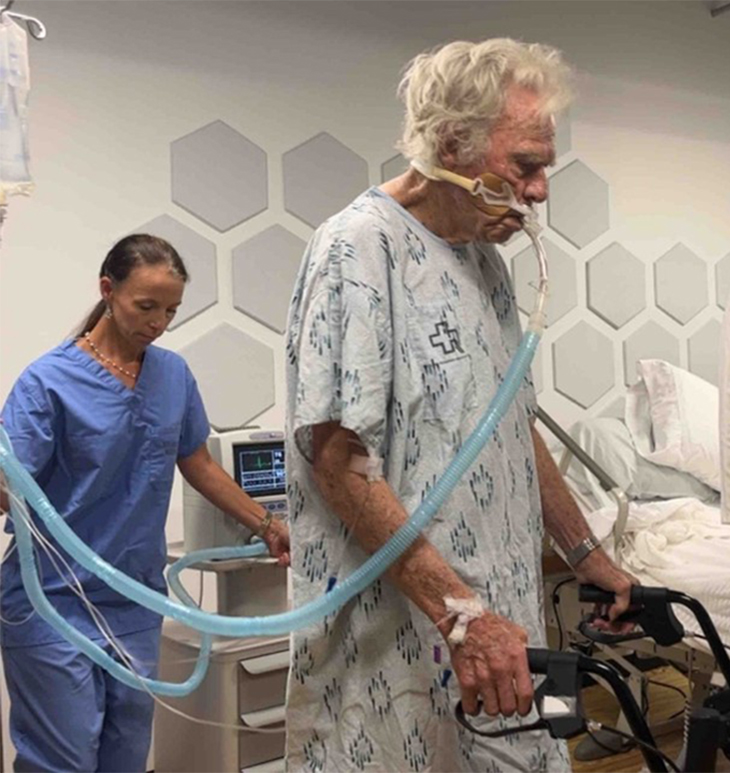
Gone are the days of induced coma for whatever ails you in critical care settings. While you may think that your institution does well with preventing delirium and restraint and having sedation-reduction goals, it's very likely that you're balancing a reduction of physical restraint with an increase in chemical restraint and vice versa. Or maybe you reduce both, but not enough, and it's only temporary for when you or the therapist has time to watch the patient, or when the family or ordering provider is present. Perhaps your site counts a brief episode of arm movement the same as sitting in a chair for 30 minutes for early mobility outcome scores. Hopefully, they're not still creating a diagnosis of pain or anxiety that allows sedating pain and anxiolytic medications.
Getting back to nurses feeling safe and not being overworked: It may seem counterintuitive, but patients with delirium and immobility complications take more nursing time and more hospital time compared to patients without those conditions. The idea is using what you have wisely and trying not to feel that a safe patient is an immobile one. Try to refrain from gasping or swan diving toward your patient when they raise their arm (assuming they have a safe restraint alternative in place). Use your restraint alternative in a way that ensures your own safety too. Chances are you will be surprised when you find the sweet spot for your patient, and peace ensues.
Enjoy knowing that your patient is not hallucinating even if they look a bit uncomfortable because they're ill. If you can change your expectation of what an ICU patient should look like, you can single-handedly save life after life and know that the reason you went into nursing is alive and well - and that you are alive and well. It will take a bit of a leap of faith and reaching outside your comfort zone at first, but the movement toward early mobility and delirium prevention along with a culture shift in ICU recovery is gaining momentum.
Regulations on Restraints
Let's talk a little about the regulatory side. The Centers for Medicare & Medicaid Services (CMS) offers guidelines your institution follows and that agencies such as The Joint Commission oversee. For the most part, your institution uses CMS guidance and creates its own policies, which The Joint Commission then carefully evaluates (unexpectedly at times) to make sure your organization and its personnel are following them. There are also laws about restraining patients. CMS guidelines for restraint are the least restrictive intervention. In the ICU, that can be anything from sitters to 'restrained because on a ventilator' to 'restrained for anxiety' and so on. It's difficult to minimize a restraint that is only on or off. You would have to either use it or not, so you'll need a device that has multiple settings that offer minimization.
New CMS Age-Friendly Hospital Reimbursement Points
In 2025, CMS implemented a new Inpatient Quality Reporting (IQR) Program known as an Age-Friendly Hospital Measure. The program links age-friendly goals to potentially improved quality scores in value-based reimbursement programs through four evidence-based elements of high-quality care for older adults, known as the 4Ms: What Matters, Medication, Mentation and Mobility. Hospitals that do not participate are subject to a significant reduction in annual Medicare payments. Hospitals are required to report whether they have protocols in place for the following five topics: Elicit patient healthcare goals; responsibly manage medication; implement frailty screening and intervention (includes cognition and mobility); assess social vulnerability; and designate age-friendly leaders. So you can see that chemical and physical restraint reduction plays a big role both from a medication standpoint and as a frailty intervention strategy.
Let's review
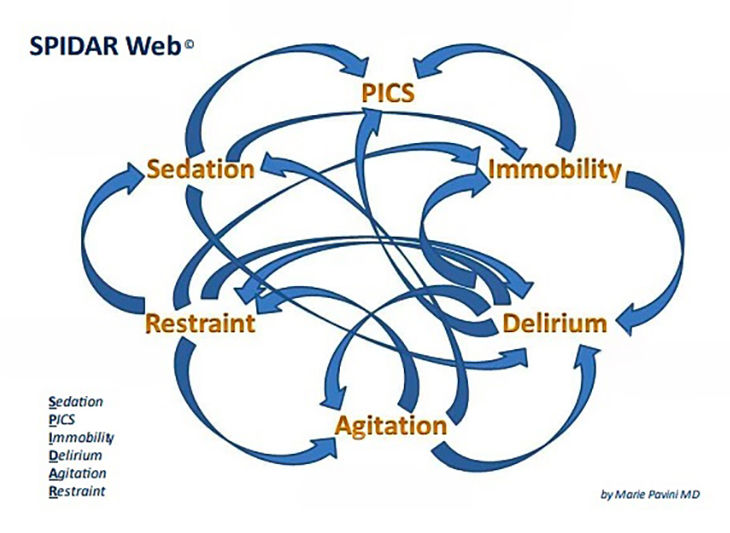
Restraint can lead to sedation.
Sedation can lead to restraint.
Restraint and sedation are independent risk factors for agitation and delirium.
Delirium can uncover or incite dementia.
Delirium can lead to post-intensive care syndrome (PICS) or post-traumatic stress disorder (PTSD).
Restraint and sedation can lead to:
- Reduced pulmonary secretion clearance and gut dysmotility from lack of thoracic and abdominal activity
- Immobility, muscle wasting and frailty
- Stasis ulcers and blood clots from immobility
- Delayed ventilator weaning and missed weaning trials
- Limited family interaction
Delirium and frailty can lead to increased readmissions, costs and staff effort.
Patient safety is critical: safety from entanglement and dislodgement of tubes and lines, safety from staff injury, safety from delirium, safety from immobility complications, safety from inhumane care causing fear and agitation
To review
Restraint can lead to sedating medications.
Sedating medications can lead to restraint.
Restraint and sedating medications are independent risk factors for agitation and delirium.
Agitation and delirium increase the risk of staff injury and effort, and worsen patient outcomes.
Please get your patients safely untied from the bed.
- Chemical and physical restraint are less safe than a safe mobility restraint alternative.
- Intubation is not a reason for chemical and physical restraint anymore.
- We can no longer think we are compliant with CMS guidelines by using a least restrictive intervention if there is a safe, less restrictive alternative.
What steps will you take in your unit to implement less harmful alternatives for restraints (even if your institution still calls them restraints) to increase mobility and compliance, and prevent delirium and PICS?

Are you sure you want to delete this Comment?